


With the spear of the child, the shield of the attack!
Fudan University has developed a drug that can inhibit Covid-19.
Broad-spectrum inhibitors of mutant strains
Novel coronavirus (COVID-19) caused by SARS-CoV-2 in 2019 poses an unprecedented threat to global public health. The continuous spread of SARS-CoV-2 in the world has led to the emergence of various variants. According to the ability of transmission and immune escape, WHO classifies these variants as variants of interest (VOI, such as Lambda) and variants of concern (VOC, such as Omicron). Among them, the recently popular VOC strain Omicron(B.1.1.529) contains 32 mutations in its S protein, which shows significant resistance to the current COVID-19 vaccine and other treatment methods, so it is urgent to develop more effective and broader-spectrum antiviral drugs against these VOCs and VOI.
On March 6th, 2022, Fudan University and Southern Medical University jointly published an article in MDPI's magazine viruses: A Five-Helix-Based SARS-CoV-2 Fusion Containing Targeting Heptad Repeat 2 Domain Against SARS-CoV-2 and Its Variants of Concern. In this study, the researchers skillfully used the ancient China principle of "spear of a child, shield of an attacker" to construct a fusion inhibitor from the peptide of SARS-CoV-2, which was expressed as 5- helix. The inhibitor can block the formation of homologous 6-helix bundle (6-HB) between virus HR1 and HR2 domains, thus blocking virus-cell fusion and effectively inhibiting the infection of SARS-CoV-2 and its VOC pseudovirus, including Delta and Omicron variants. 5- helix can also inhibit the infection of SARS-CoV-2 wild-type (nCoV-SH01) strain and its Delta variant true virus.
Why is it easy for Covid-19 to escape from the vaccine antibody?
Generally, the S protein of SARS-CoV-2 is divided into two subunits, S1 and S2. Functional domains in S1 subunit (such as RBD) are the most important targets for developing neutralizing antibody therapies and vaccines, but they are also prone to natural mutation because they exist on the surface in the natural conformation with the virus and are exposed to the host immune system. This is why the mutant Omicron is so resistant to most neutralizing antibodies targeting RBD.
S2 subunit has a high genetic barrier.
There are two functional domains called heptapeptide repeats 1(HR1) and 2(HR2) in S2 subunit of spike (S) protein of SARS-CoV-2, which play a key role in forming the fusion core of six-helix bundle (6-HB) and mediating the virus to enter the host cell.
Most of S2 subunit is shielded by S1 subunit in natural conformation, therefore, S2 can neither induce nor be recognized by antibodies in most cases, and the chance of mutation is small. HR1 and HR2 domains in S2 subunit are only briefly exposed for a few minutes immediately after RBD in S1 binds to ACE2 receptor of target cells. Even in the intermediate state of fusion, the antibody IgG with molecular weight of 150 kDa can not enter the HR1 and HR2 domains, and it has steric hindrance to the molecules > 40 kDa. Therefore, HR1 and HR2 domains are the most conserved regions in coronavirus S protein. Therefore, antiviral drugs targeting HR1 and HR2 domains are expected to have a high genetic barrier to drug resistance.
turn sb's battery against himself
It is worth mentioning that researchers have previously identified a series of peptide-based fusion/entry inhibitors for various viruses, such as targeting HIV-1(SJ-2176), SARS-CoV(SC-1), MERS-CoV(MERS-HR2P), HCoV-OC43(OC43-HR2P) and SARS-CoV.
Although HR2 has a more conservative sequence than HR1, so far, there is no report on HR2 peptide targeting SARS-CoV-2 S protein. Considering that the amino acid sequence of HR2 domain is more conservative than that of HR1, HR2 should be a better target for developing broad-spectrum HCoV fusion/entry inhibitors.
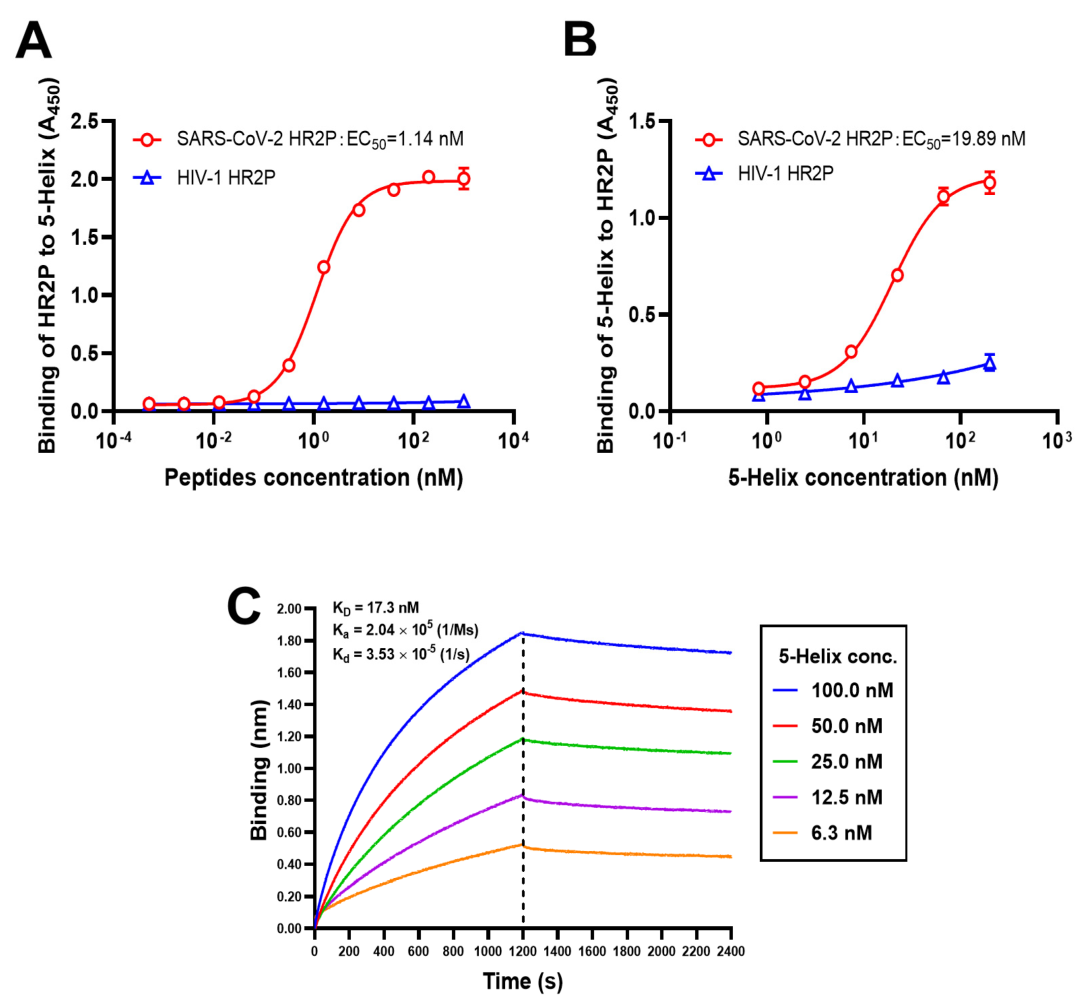
Therefore, in this study, the researchers designed and constructed a 5- helix protein consisting of three HR1 and two HR2 parts from the HR1 and HR2 regions of SARS-CoV-2 S2 subunit. The 5- helix protein shows a helix structure with high α helicity, and the Tm value is ~ 52 C. It can bind to SARS-CoV-2 HR2P peptide and has high affinity (KD= 17.3 nM). In competitive experiments, it was found that 5- helix can interact with the HR2 peptide of SARS-CoV-2 to form 6-HB, thus effectively inhibiting the formation of 6-HB between HR1 and HR2 of SARS-CoV-2, and inhibiting SARS-CoV-2 and its variants from infecting cells.
5- helix is very effective in virus-cell fusion mediated by SARS-CoV-2 S, and it inhibits the infection of SARS-CoV-2 WT(D614G) and five VOC pseudoviruses, including α, β, γ, Delta and Omicron variants and a VOI (Gamma variant). It is almost equally effective against wild-type SARS-CoV-2 (nCoV-SH01) and Delta variant true virus infection.
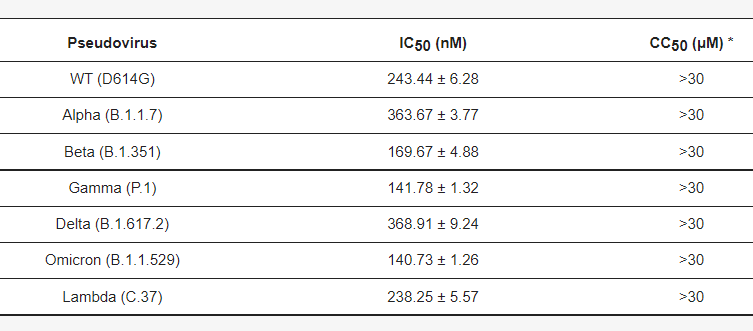
The results show that 5- helix can effectively target not only wild-type SARS-CoV-2, but also its mutants. Considering the continued prevalence and variation of Covid-19 in the world, the fusion inhibitor can be further developed as a therapeutic or preventive drug for SARS-CoV-2 and its variant infection.
This article and pictures are reproduced from other websites. If there is any infringement, please contact to delete!


 备案号:沪ICP备20003873号-1