


Zhang Qiwei and Wu Jianguo discovered the important mechanism of gene recombination of Omicron mutant in Covid-19.
Recently, Wu Jianguo and Professor Zhang Qiwei, the research team of pathogenic microorganisms in Jinan University, published the latest important discovery about the mutant of Omicron in Covid-19: "Tracking SARS-CoV-2 Omicron" in the sub-journal of Nature (IF: 18.187). diverse spike gene mutations identifies multiple inter-variant recombination events”。 In this study, the whole genome sequence and Spike gene of Covid-19 Omicron mutant (BA.1 and BA.2) in the early stage of epidemic were carefully analyzed. For the first time, it is found that there have been many important mechanisms of cross-variant gene recombination between Omicron mutant and variants of concern (VOC)/variants of interest (VOI) strains such as Alpha, Beta and Delta. It is speculated that the recombinant "Deltacron-like Variant" produced by Omicron strain and Delta strain was the earliest in November 2021. It is suggested that the prevention and control of infection and transmission of Covid-19 in immunocompromised population and unvaccinated population should be strengthened, and the aggregation of infected people with different COVID-19 variants should be strictly avoided, which will help to block the generation of new virus variants.
At present, the COVID-19 pandemic around the world is mainly caused by the more infectious Omicron mutant strain, which is the most mutated type of Covid-19 at present. It was first discovered in Africa in November 2021, and the world pays close attention to the COVID-19 mutant strain that appears at present. Gene recombination is an important evolutionary mechanism for new and reappearing viruses, and it is also an important way for coronavirus to evolve and adapt. Coronavirus can accumulate multiple mutations after a single evolutionary event through gene recombination, which leads to the improvement of virus infectivity and/or immune escape. Because the sequences of epidemic strains in Covid-19 are highly similar and relatively conservative in evolution, it is difficult for classical recombinant detection methods to determine the recombinant signals and evolutionary trajectories of different strains.
Covid-19 s protein
Covid-19 S protein is mainly responsible for receptor recognition and mediating virus invasion into host cells. The mutation of amino acid sequence of S protein can change its binding efficiency with cell receptors, thus affecting the infectivity and infectivity of the virus. In addition, S protein is immunogenic, with many T lymphocyte and B lymphocyte epitopes. The mutation of antigen recognition site will lead to the change of binding efficiency between neutralizing antibody and antigen, affect the neutralizing effect of antibody, and even lead to antigen drift and immune escape.
Team research process
At first, the research team made a comprehensive and detailed analysis of 52,563 sequences of S gene of Covid-19 Omicron mutant which was popular before January 15th, 2022, and found that the early Omicron mutant had carried many characteristic amino acid mutations of previous popular strains, suggesting that the S gene of Omicron mutant had experienced many gene recombination events (Figure 1). Further study found that Omicron BA.1 subtype contained 18 core mutations and Omicron BA.2 subtype contained 27 core mutations, suggesting that Omicron BA.2 subtype had stronger immune escape ability. Compared with the VOC mutant, the Omicron mutant has nine common amino acid mutations in S protein, which indicates that the mutant may come from the recombination of some VOC strains.

Fig. 1. Omicron strain BA.1 subtype shares 6 mutations (del69-70, delY144, N501Y, D614G and P681H) with Alpha strain, 3 mutations (K417N, N501Y and D614G) with Beta strain and 3 mutations (N501Y, D614G and H655Y) with Gamma strain.
By analyzing the genome sequence of Omicron mutant released from November, 2020 to January, 2021, the research team found that during the epidemic period, Omicron mutant continuously added and integrated multiple amino acid mutations from other mutants. Most notably, the receptor binding domain (RBD) of Omicron mutant S protein has L452R and R346K mutations, which may be obtained by recombination with Delta and Miu (B.1.621) mutants. These mutations lead to the decrease of binding efficiency of neutralizing antibody and the enhancement of virus immune escape ability (Figure 2).
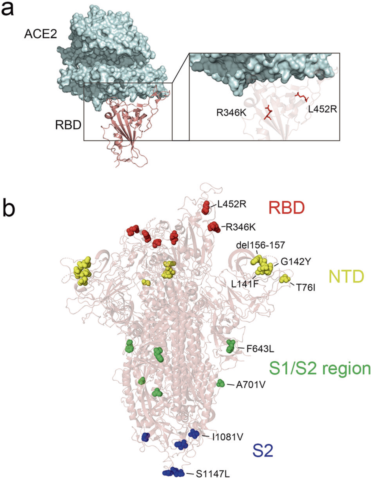
Fig. 2. Amino acid mutations from other mutants obtained from spike protein of Omicron mutant.
A phylogenetic network was established for S protein sequences published worldwide from November 2021 to January 2022. It was found that during the first two months of epidemic in Omicron, the haplotypes of S protein were polymorphic, mainly BA.1 subtype. On the basis of BA.1, further sub-groups integrating S protein mutations such as A701V, R346K and L452R, sub-varieties of BA.2 and Reversion have evolved (Figure 3). During the initial co-epidemic period of Omicron mutant with other mutants, many recombination events have occurred, and gene transfer with characteristic mutations of other mutants has been obtained. Sequence exchange between Omicron mutant and other strains that were popular earlier led to partial primary mutation loss and Reversion of S gene of Omicron mutant, but the amino acid sequence was closer to the original strain (Figure 3), which may be more suitable for human transmission. This is the first report of the reversion mutation of Omicron mutant, which needs to be paid close attention to.

Fig. 3. (a) The S gene of Omicron mutant showed certain genetic polymorphism, forming multiple subgroups. (b) Some regions of S gene in some subgroups showed atavism. (c) Schematic diagram of the recombinant evolution of Omicron mutant.
L452R mutation of S gene is a characteristic mutation carried by Delt mutant. The research team traced back and analyzed the whole genome of the Omicron strain suspected to be a "Deltacron-like Variant" carrying the mutation of Delta mutant L452R, and found that Delta Cron-like variant was detected in many countries around the world. As early as November 2021, Omicron recombinant strain was found in COVID-19 samples collected in South Africa and Botswana. The recombinant strain was mainly distributed in North America, Europe and West Asia (Figure 4). The recombinant Omicron mutant also showed polymorphism at the whole genome level, and more evolutionary branches were derived, suggesting that Omicron mutant and other strains may be co-infected (Figure 4). Deltarjon-like mutation of L452R was also found in some S genes of Omicron BA.2 subform, so it is necessary to pay close attention to the appearance of similar mutations in the future.
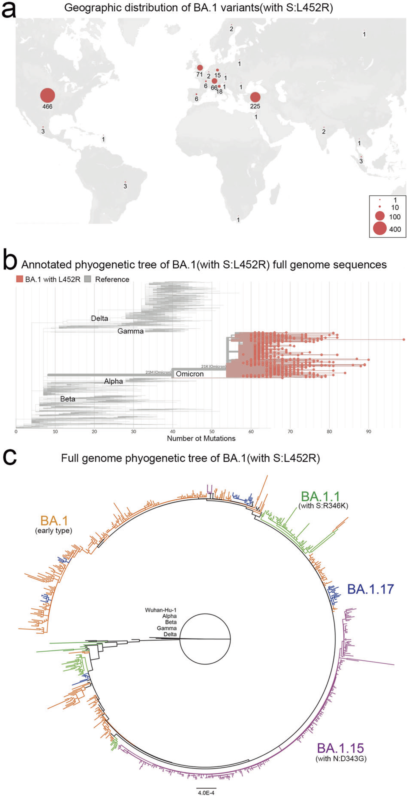
Fig. 4. (a) Global distribution of Deltacron-like BA.1 with L452R mutation. (b) The whole gene phylogenetic tree with L452R mutation of Deltacron-like BA.1 showed sequence polymorphism. (c) The whole genome phylogenetic tree carrying the Deltacron-like BA.1 subtype with L452R mutation.
Through the analysis of S gene sequences of a large number of Omicron mutants, it was found that there were many cross-mutation recombination events of S genes in Omicron and other mutants. Co-infection and subsequent gene recombination promoted the continuous evolution of Covid-19, resulting in changes in virus infectivity and immune escape ability. Therefore, continuous monitoring of Covid-19 gene recombination is very important for understanding the evolution and traceability of the virus, especially for preventing the emergence of new mutant strains; The research and development of anti-Covid-19 drugs and vaccine design also need to consider the influence of virus gene recombination.
Professor Zhang Qiwei and Professor Wu Jianguo from the Institute of Pathogenic Microbiology of Jinan University/Guangdong Provincial Key Laboratory of Virology are the corresponding authors of the paper, and Dr. Ou Junxian is the first author of the paper. Professor James Chodosh from Harvard Medical School and Professor Donald Seto from George Mei Sen University provided technical guidance and help for this study. This research is supported by the national key R&D program, the national key natural science fund and the Guangdong natural science fund.
This article and pictures are reproduced from other websites. If there is any infringement, please contact to delete!


 备案号:沪ICP备20003873号-1