


A new candidate vaccine named "mosaic-8" contains eight different SARS-like β -coronavirus fragments, which provides extensive protection against other related coronaviruses.
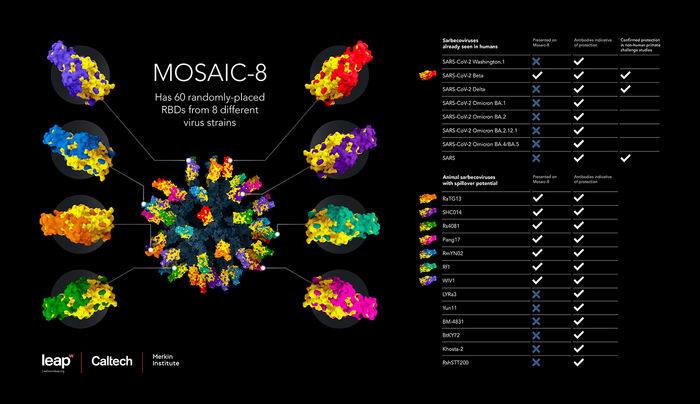
This infographic shows that the new vaccine consists of RBD from 8 different viruses. The table shows the broad spectrum of SARS-CoV-2 variant and the related coronavirus that vaccine can induce protection.
According to a study conducted by researchers in Pamela Bjorkman's laboratory, a professor of biology and bioengineering at David Baltimore, California Institute of Technology, a new vaccine provides protection against various SARS-like beta coronaviruses in mice and monkeys, including the SARS-CoV-2 variant.
Beta coronaviruses, including those that cause SARS, MERS and COVID-19 pandemics, are a subset of coronaviruses that infect humans and animals. The working principle of this vaccine is that spike protein fragments from SARS-CoV-2 and seven other SARS-like coronaviruses are placed on protein nanoparticles to induce a wide range of cross-reactive antibodies. It is worth noting that when the so-called mosaic nanoparticles are inoculated, the animal model is not affected by another coronavirus, SARS-CoV, which is not among the eight coronaviruses in the nanoparticle vaccine.
Alexander Cohen (21st doctor), the co-first author of this new study and a postdoctoral scholar at California Institute of Technology, said: "The antibodies produced by animals inoculated with mosaic-8 nanoparticles can recognize almost every SARS-like β -coronavirus strain we evaluated. Some of these viruses may be related to the strains that cause the next SARS-like β -coronavirus outbreak, so what we really want is something aimed at this core virus group. We believe that we have this ability. "
The study was published in the July 5th issue of Science.
Bjorkman said: "SARS-CoV-2 has proved its ability to produce new varieties, thus prolonging the global COVID-19 pandemic. In addition, the fact that three kinds of β -coronaviruses have spread from animal hosts to humans in the past 20 years shows that it is necessary to produce a wide range of protective vaccines.
"This kind of extensive protection is necessary, because we can't predict which of a large number of viruses in animals will evolve to infect humans in the future, leading to another epidemic or pandemic. What we are trying to do is to make an integrated vaccine that can resist the beta coronavirus similar to SARS, no matter which animal virus may evolve to allow human infection and spread. This vaccine can also prevent current and future SARS-CoV-2 variants without updating. "
Working principle: A vaccine consisting of 8 different spike domains of SARS-like coronavirus.
The vaccine technology of attaching virus fragments to protein nanoparticles was originally developed by collaborators at Oxford University. The technology is based on a tiny cage-like structure ("nanoparticles") consisting of protein with "sticky" appendages on its surface, to which researchers can attach the labeled virus protein. These nanoparticles can be prepared to show fragments of only one virus ("homotype" nanoparticles) or fragments of several different viruses ("mosaic" nanoparticles). When injected into animals, nanoparticle vaccines present these virus fragments to the immune system. This leads to the production of antibodies, the protein of immune system to recognize and fight against specific pathogens, and the cellular immune response involving T lymphocytes and innate immune cells.
In this study, the researchers selected eight different SARS-like β-coronaviruses-including SARS-CoV-2 virus that caused COVID-19 pandemic and seven related animal viruses that may cause pandemic in humans-and attached the fragments of these eight viruses to nanoparticle scaffolds. The research team selected a specific fragment of the virus structure, called receptor binding domain (RBD), which is essential for coronavirus to enter human cells. In fact, human antibodies that neutralize coronavirus mainly target RBD of the virus.
Their idea is that such a vaccine can induce human body to produce antibodies that widely recognize SARS-like β-coronavirus, and counter the variation on nanoparticles by aiming at the common characteristics of virus RBDs. The idea of this design is that the diversity and physical arrangement of RBD on nanoparticles will focus on the immune response of some RBD shared by the whole SARS coronavirus family, so as to realize the immunity of all people. The data published in the journal Science today shows the potential efficacy of this method.
Design experiments to measure the protective effect of vaccine on mice.
The resulting vaccine (called "mosaic-8" here) consists of RBD of eight coronaviruses. Previous experiments led by Bjorkman Laboratory showed that mosaic-8 induced mice to produce antibodies to various coronaviruses in laboratory culture dishes (Cohen et al., 2021, Science). The new research led by Cohen aims to build on this research and see whether vaccination with mosaic-8 vaccine can induce protective antibodies when live animals are challenged by SARS-CoV-2 or SARS-CoV (in other words, infected).
The purpose of the research team is to compare the protective degree of nanoparticles covering different coronavirus fragments (mosaic-8) with nanoparticles covering only SARS-CoV-2 fragments (a kind of "homogeneous" nanoparticles) against infection.
The team conducted three groups of experiments on mice. The first group is the control group, and they only inoculated mice with nano-particle cage structure without any virus fragments attached. The second group of mice were injected with a homogeneous nanoparticle covering only SARS-CoV-2 rbd, and the third group was injected with a mosaic-8 nanoparticle. One of the experimental objectives is to observe whether inoculation with mosaic-8 can protect animals from SARS-CoV-2 infection to the same extent as that of animals immunized with SARS-CoV-2. The second goal is to evaluate the protection against the so-called "mismatch virus", which has no RBD on mosaic-8 nanoparticles.
It is worth noting that the eight coronaviruses covered with chimeric nanoparticles deliberately did not include SARS-Cov, which caused the initial SARS epidemic in the early 21st century. Therefore, the research team also aims to study the degree of protection against the original SARS-CoV virus, and use it to represent an unknown SARS-like β-coronavirus, which may spread to humans.
The mice used in the experiment can express human ACE2 receptor through genetic modification. ACE2 receptor is the receptor that Covid-19 and related viruses enter human cells when they infect them. In this animal attack model, unvaccinated mice will die if they are infected with SARS-like β coronavirus, which provides a rigorous test for evaluating the potential of protecting human beings from infection and disease.
Protect mice from SARS-like β -coronavirus infection
As expected, mice inoculated with naked nanoparticles did die when infected with SARS-CoV or SARS-CoV-2. Mice inoculated with homogeneous nanoparticles only wrapped with SARS-CoV-2 RBD had protective effect on SARS-CoV-2 infection, but died when exposed to SARS-CoV. These results indicate that the homogeneous sars-CoV-2 nanoparticle vaccine currently being developed in other places may be effective against SARS-CoV-2, but it may not be able to widely protect other SARS-like β-coronaviruses from animal hosts or future SARS-CoV-2 variants.
However, all the mice inoculated with mosaic-8 nanoparticles survived both SARS-CoV-2 and SARS-CoV challenges without weight loss or other significant pathological changes.
The research on nonhuman primates also confirmed the effectiveness of mosaic vaccine.
Then, the team conducted a similar challenge experiment on non-human primates, this time using the most promising candidate vaccine, mosaic-8, and compared the effects of mosaic-8 vaccination and unvaccinated vaccine in animal challenge research. When inoculated with mosaic-8, animals showed almost no detectable infection when exposed to SARS-CoV-2 or SARS-CoV, which once again showed that mosaic-8 candidate vaccine may play a protective role in the current and future virus variants that caused COVID-19 pandemic, and prevent the potential virus overflow of SARS-like β-coronavirus from animal hosts in the future.
Importantly, in cooperation with Jesse Bloom, a virologist of Fred Hutchinson Cancer Research Center, the research team found that the antibodies triggered by mosaic-8 targeted the most common elements of RBD in a series of other SARS-like β-coronaviruses (the so-called "conservative" part of RBD), thus providing evidence for the hypothetical mechanism that the vaccine can effectively fight against new varieties of SARS-CoV-2 or SARS-like β-coronaviruses in animals. In contrast, the antibodies induced by the injection of homogeneous SARS-CoV-2 nanoparticles are mainly directed at the strain-specific RBD region, which indicates that these types of vaccines may have a protective effect on SARS-CoV-2, but they have no protective effect on the newly mutated or potentially emerging animal viruses.
Next, Bjorkman and his colleagues will evaluate the immunity of human mosaic -8 nanoparticles in a phase I clinical trial supported by the Alliance for Epidemic Prevention Initiative (CEPI). The clinical trial will mainly recruit people who have been vaccinated and/or infected with SARS-CoV-2 before. In order to prepare for the clinical trial, Bjorkman Laboratory is planning to conduct preclinical animal model experiments to compare the immune response of animals previously vaccinated with the current 2019 coronavirus disease vaccine with that of animals that are immune to SARS-CoV-2 infection or vaccination.
Dr Richard J. Hatchett, CEO of the Epidemic Prevention Alliance, said: "Since the beginning of the pandemic, we have discussed the necessity of diversifying vaccine development. The breakthrough demonstrated by new research shows the great potential of a strategy to seek a new vaccine platform, which may overcome the obstacles caused by new variants. I am pleased to announce that the Innovation Alliance for Epidemic Prevention will support this new method of pandemic prevention in the first phase of clinical trials. "
This article and pictures are reproduced from other websites. If there is any infringement, please contact to delete!


 备案号:沪ICP备20003873号-1