


In recent days, XBB has been madly swiping the screen, and XBB has attracted the attention of the whole network, and it has been connected with 2 hot searches! It is said that XBB can cause secondary infection, and mainly focuses on the intestine and brain? ? What is XBB, what do experts at home and abroad think of scientific research? This article will synthesize the latest information at home and abroad!
PART ONE
What is XBB?
Omicron has evolved more than 400 progeny lineages. In the weekly report of WHO, it is pointed out that during the month from September 24th to October 24th, all the COVID-19 sequences shared through GISAID belong to Omicron and its progeny lineages, among which BA.5 and its progeny lineages continue to dominate, and BA.4 (including BA.4.6) and its progeny lineages account for 77.1% of the submitted sequences. The prevalence of BA.2 (including BA.2.75) and its progeny pedigree increased, accounting for 4.3%. Recently, the recombinant mutant strains accounted for 1.4% of the shared sequences, mainly due to the growth of XBB and its progeny pedigree.
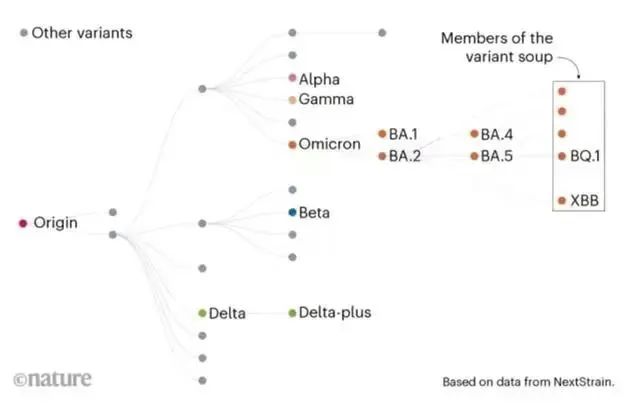
At present, BQ.1 and XBB are the two most popular mutant families. BQ.1 originated from BA.5 strain in Omicron, and its subsidiary BQ.1.1 has become the main epidemic strain in the world. As a recombinant of two Omicron BA.2 offspring mutants, XBB has strong immune escape ability, and it became the main epidemic strain in Singapore within two weeks after its appearance, and India was basically occupied by XBB. They are widely popular in Europe and America, and the upward trend is remarkable.
XBB is probably the most immune escape strain in COVID-19 so far. It is a combination of two different Omicron variants. In Asian countries including Singapore, Bangladesh and India, XBB has triggered a new wave of infection. The World Health Organization reported that this variant has been found in 26 countries. As early as November 2022, Ben WeChat official account published an article:
Nature: what a mess! COVID-19 mutant is rampant, and the poison king is already in the battle?
The main points are as follows:
XBB may become a new generation of drug king
The receptor binding domain (RBD) of Covid-19 spike protein is necessary to infect cells, and the mutation in RBD can help the virus escape the immune barrier caused by vaccines and previous infections. Cornelius Roemer, an expert on virus evolution in university of basel, observed that the more key RBD mutations a mutant has, the faster it seems to spread. For example, the number of mutants with five key RBD mutations (relative to BA.2), such as BQ.1, seems to increase more slowly than that with six key RBD mutations. BQ.1.1, the descendant of BQ.1, is a mutant with six key RBD mutations, which is rapidly rising in Europe, North America and other places, while XBB has seven key RBD mutations, which may lead to XBB's better communication ability than BQ.1.1. Researchers are still monitoring countries where BQ.1.1 and XBB are popular at the same time to see which one spreads faster. Scientists in Australia and India, by counting the results of SARS-CoV-2 gene sequencing in their own countries, have noticed that XBB is gaining the spread advantage, so they tend to think that XBB will be the main force in the next round of epidemic. The laboratory results of Chinese scientists support this view. Cao Yunlong, an associate researcher in Changping Laboratory and Peking University Biomedical Frontier Innovation Center, found that XBB's immune escape ability is the strongest among the variant viruses for the time being, and its immune escape ability is obviously higher than that of BA.2.75.2 and BQ.1.1, and also higher than that of BR.2, BM.1.1.1 and CA.1 Cao Yunlong said that XBB can avoid antibodies against NTD(N-terminal domain), which may enable it to infect people who are immune to BQ.1 and its descendants. However, BQ.1 is also frantically acquiring NTD mutations, which may make the prevalence of XBB and BQ.1.1 different in different regions, and it is possible that the two will divide the world.
PART TWO
Is there XBB in China? Yes!
Xu Wenbo, director of the Institute of Virology, China CDC, said that BF.7, BQ.1 and XBB have been detected in China in the past three months. More than 130 subfamilies of Omicron have been imported into China, and 50 subfamilies have caused related local cases or outbreaks, including BQ.1 and XBB. Among them, BQ.1 and its subfamilies were detected in 49 cases in 9 provinces, and 11 in 3 provinces. BQ.1 and XBB have not yet formed dominant communication in China, and at present, BA.5.2 and BF.7 are the main ones, but their communication advantages will gradually increase, and they may form a co-circulation with BA.5.2 and BF.7 and other more than 50 input sub-branches.
PART THREE
Is the vaccine useful?
The vaccine as a whole has little effect! The recent research of He Dayi's team shows that the vaccine effect is seriously reduced. The study first evaluated the neutralization effect of serum of people vaccinated with 3 or 4 doses of mRNA vaccine and the second generation of mRNA vaccine (including BA.4/5 antigen) in the face of original strains and new variants. The results showed that no matter what kind of vaccine was inoculated, the neutralizing titer of the population serum showed a significant decline in the face of new mutant strains.
Among them, both BA.2 and BA.4/5 showed stronger immune escape effect than the original strain D614G. Compared with D614G, the neutralization titer ID50 of BA.2 and BA.4/5 decreased by 2.9 ~ 7.8 times and 3.7 ~ 14 times, respectively. What is even more worrying is that after three doses of mRAN vaccine were inoculated, the neutralization titer of BQ.1, BQ.1.1, XBB and XBB.1 was much lower than that of D614G, and the neutralization titer decreased to 37~71 times.
In order to understand the types of serum antibodies that lost neutralizing activity to BQ.1, BQ.1.1, XBB and XBB.1, pseudoviruses were constructed for each mutant, and then their neutralizing sensitivity to 23 monoclonal antibodies (MABs) targeting various epitopes on S protein was evaluated to clarify the reasons behind the loss of neutralizing activity in serum.
Studies have shown that the new mutant is completely or partially resistant to the neutralization of most monoclonal antibodies detected. BQ.1 and BQ.1.1 are basically completely resistant to antibodies targeting class 1 and class 3 epitopes of RBD, while XBB and XBB.1 are almost completely resistant to antibodies targeting class 1, class 2 and class 3 epitopes of RBD. The previous SARS-CoV-2 mutant has stopped using a number of clinically approved therapeutic antibodies, and bebtelovimab is the last available monoclonal antibody against SARS-CoV-2 mutant. Unfortunately, BQ and XBB sub-lines are now completely resistant to bebtelovimab.
In addition, the combination of Evusheld monoclonal antibodies authorized to prevent COVID-19 is completely ineffective against the new mutant. In a word, the antibody resistance characteristics and virus receptor binding affinity of SARS-CoV-2 Omicron BQ.1, BQ.1.1, XBB and XBB.1 mutants were studied in detail. The new mutant strains were hardly infected or vaccinated in the past, including the latest bivalent (WA1-BA.5) mRNA vaccine to strengthen the neutralization of serum. As a result, breakthrough infection and reinfection surged.
PART FOUR
Do you specifically attack the intestines and cerebral vessels?
COVID-19 invaded human cells by what? Spike protein binds to human ACE2 receptor The same is true for XBB. The organ it invades also depends on the distribution of ACE2 receptors. Like the previous virus strains, it will be mainly respiratory tract. How did it become a special attack on cardiovascular and cerebrovascular diseases and intestines?
Therefore, don't believe or spread the rumor that XBB.1.5 specifically attacks cardiovascular and cerebrovascular diseases and intestines, and don't blindly follow the trend. Later, switch to another mutant and say where to attack, what special symptoms are there, and what special drugs are needed. Don't believe it.
The immune escape of Omicron virus strains, including XBB.1.5, is mainly for infection. The prevention of severe illness is less dependent on the existing neutralizing antibodies in the human body, and it is less affected. Vaccination and past infections can also reduce the risk of serious illness.
PART FIVE
Will XBB cause secondary infection? Yes!
XBB may spread faster, and the pathogenicity of XBB, BQ.1 and BQ.1.1 is similar to that of the previous strains, but the immune escape ability has increased. Therefore, the virus may spread faster than before.
If these strains are encountered, the probability of reinfection mainly depends on two aspects: on the one hand, how much the re-encountered strains overlap with BA.5 and BF.7, and if the virus keeps mutating, the cross-protection effect will be reduced, which may cause infection; On the other hand, it is to look at the level of human autoantibodies.
Regarding whether the risk of reinfection of the new strain will increase, Li Dong, chief physician of the Department of Respiratory and Infectious Diseases of Beijing You 'an Hospital, once said:
"At present, the immune escape ability of XBB strain has been enhanced, which is different from that of BA.5, which is popular in China. After being infected with BA.5 for a period of time, the level of protection will decrease, and the risk of reinfection will increase when encountering a strain with strong immune escape ability. However, reinfection mainly occurs in some people with low immunity. People with normal immune function have less risk of reinfection in a short time, and the symptoms after infection are usually milder than the first time. "
Regarding reinfection, Lu Hongzhou, president of Shenzhen Third Hospital, said: Israeli statistics show that the reinfection rate of COVID-19 in Israel has increased with the prevalence of new strains in the past year. In recent weeks, under the pandemic of BQ.1.1 and XBB mutants, the reinfection rate in COVID-19 has increased from 20% to 35%, and it is still increasing. During the epidemic period of BA.1 and BA.5 mutants, the peak of reinfection rate was 15% and 20% respectively.
This means that group immunization has a weak effect on preventing the infection of BQ.1 and XBB new mutants, and the new mutants will escape the immune barrier established by previous vaccination and natural infection.
"Although COVID-19 will not be infected in a short time, such as three to four months, it is undeniable that the new strain is popular or shortens the safety window for secondary infection. Therefore, in European and American countries, some people with poor immunity may be infected many times a year. "
This article and pictures are reproduced from other websites. If there is any infringement, please contact to delete!


 备案号:沪ICP备20003873号-1