


Metabolic associated fatty liver disease (MAFLD) is a class of metabolic liver diseases that are affected by multiple factors such as genes and environment. It has a significantly increased risk of further development into cirrhosis and liver cancer, and can promote the occurrence of arteriosclerotic cardiovascular and cerebrovascular diseases, chronic kidney disease, and tumors [1,2]. Insulin resistance, endoplasmic reticulum stress, intestinal flora disorders, and genetic factors may be involved in the progression of MAFLD [3], but its pathogenesis has not yet been fully elucidated.
On March 14, 2023, Professor Huang Ailong/Tang Ni, the research group of Key Laboratory of Molecular Biology of infectious diseases, Ministry of Education, Chongqing Medical University, published the latest research results online in Nature Communications magazine entitled "Definition of gluconic economy PCK1 promotes metabolic associated fatty liver disease (MAFLD) through PI3K/AKT/PDGF axis activation in male mice [4]. This study is the first to find that the deletion of phosphoenolpyruvate carboxyl kinase 1 (PCK1), a key enzyme in gluconeogenesis, leads to lipid deposition in liver cells, which activates stellate cells by activating the RhoA/PI3K/AKT/PDGF-AA signal axis, promoting the development of liver fibrosis. Intervention strategies such as targeting RhoA/AKT signaling pathways will provide new therapeutic strategies and targets for MAFLD.
The research team first analyzed the GEO database data and found that the expression of PCK1, a key enzyme for gluconeogenesis in the liver tissues of MAFLD patients, was significantly down-regulated. In vitro palmitic acid (PA) treatment simulated the metabolic environment of MAFLD, confirmed that PA upregulated the negative transcriptional regulator ATF3, inhibited the transcription of PCK1 gene, and revealed a new mechanism of low expression of PCK1 in the environment of lipid metabolism disorders. In order to investigate the potential role of PCK1 in the progression of MAFLD, the research team established a high-fat diet model combined with high-fructose/glucose drinking water feeding [5], and found that hepatocyte-specific knockout of Pck1 can promote liver inflammatory response and fibrotic lesions. In the cPtenf/fPck1f/f knockout mouse model, it was found that the liver damage and lipid metabolism disorders of cPtenf/f1f/f mice were more severe than those in cPtenf/f mice, suggesting that Pck1 deletion further aggravated liver steatosis, inflammation and fibrosis in the genetic animal model of Ptenf/f. The use of adeno-associated virus AAV-Pck1 to restore PCK1 expression can delay the progression of MAFLD, confirming that PCK1 has an important protective effect in MAFLD progression.
In order to reveal the molecular mechanism of PCK1 deletion in hepatocytes promoting the progression of MAFLD, the researchers found that PCK1 deletion in hepatocytes can promote fatty acid transport and lipid droplet formation related genes such as CD36, CIDEC and other up-regulated expression through transcriptome sequencing and target and non-target metabolomics detection, and the accumulation of triglyceride synthesis substrate 3-phosphoglyceraldehyde. Through primary hepatocytes and stellate cell co-culture experiments, the researchers found that PCK1 deletion can increase the secretion of platelet-derived growth factor AA (PDGF-AA) in hepatocytes by activating the RhoA/PI3K/AKT signaling pathway, and promote the activation of co-cultured liver stellate cells. Intervention with AKT and RhoA by lentiviral vector-mediated gene methods or inhibitors delayed the progression of MAFLD in hepatic-specific knockout PCK1 mice.
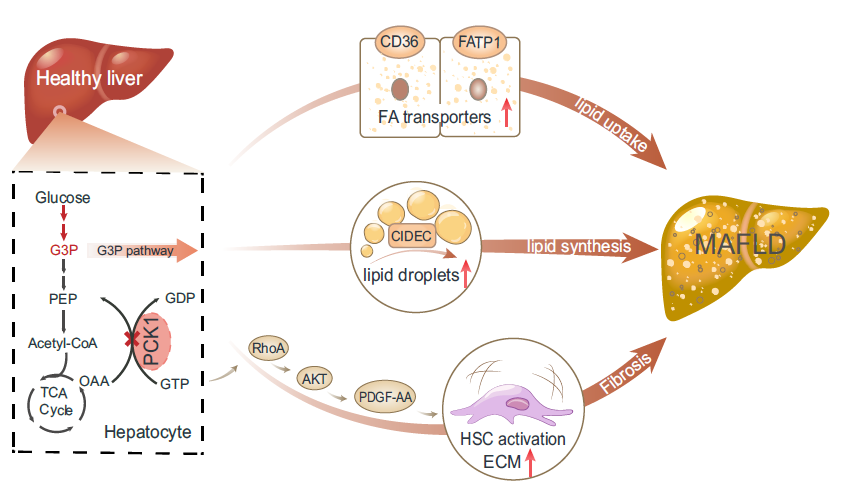
Mechanism diagram of PCK1 regulating the progression of fatty liver disease associated with metabolic disorders
The above study found that PCK1 deficiency can lead to lipid deposition in hepatocytes and promote liver fibrosis and MAFLD progression by activating the RhoA/PI3K/AKT/PDGF-AA signaling axis. The above results reveal the molecular mechanism of PCK1, the key enzyme of gluconeogenesis, regulating the progression of MAFLD through the regulation of glycolipid metabolism in the form of "hepatocyte-stellate interactive dialogue". Intervention in PCK1 downstream target genes and signaling pathways may provide new targets and new ideas for MAFLD therapy.
Dr. students Ye Qian, Liu Yi, Zhang Guiji, associate researcher Deng Haijun, Wang Xiaojun of Southwest Hospital of Army Medical University and Yu Lin of Sichuan Provincial People's Hospital are co-first authors of the paper, and Professor Huang Ailong, Professor Tang Ni and Associate Professor Wang Kai of Chongqing Medical University are co-corresponding authors of the paper.
This article and pictures are reproduced from other websites, if there is infringement, please contact to delete!


 备案号:沪ICP备20003873号-1