


Alphavirus is a class of RNA viruses transmitted by arthropods such as mosquitoes, belonging to the family Togaviridae, which can widely infect humans, birds, rats, horses and other animals and cause related diseases. Alphavirus infection in humans can cause fever, severe and persistent headache, muscle pain, and arthralgia. Some alphaviruses can infect nerve cells and cause infections of the central nervous system, causing severe encephalitis. To date, no drugs or vaccines have been approved to treat or prevent alphavirus infection.
In recent years, there have been a series of important advances in the study of the mechanism of alphavirus infection. Among them, the molecular mechanism of the binding of chikungunya virus (CHIKV) to its receptor Mxra8, and the molecular mechanism of binding of Venezuelan equine encephalitis virus (VEEV) to its receptor LDLRAD3 have been elucidated. However, according to existing research, it is not possible to explain why alphavirus can widely infect a wide range of species, from non-vertebrates to vertebrates, and the evolutionary relationship spans widely.
A 2021 study reported that the apolipoprotein receptor VLDLR (very-low-density lipoprotein receptor) is a universal receptor for multiple species of beetleviruses, including Semliki Forest Virus (SFV), which infect mosquitoes, rats, horses, and humans. However, the mode of binding of viruses to such receptors and the mechanism of cross-species transmission mediated by them are unknown. Recently, Cell magazine published online a research paper co-completed by Zhang Xinzheng's research group of the Institute of Biophysics of the Chinese Academy of Sciences and Xiang Ye's research group of Tsinghua University School of Medicine, which analyzed the high-resolution cryo-EM structure of SFV and human receptor VLDLR complexes, identified a new receptor binding site for alphavirus, and revealed a novel mechanism of specific binding of multiple similar tandem domains of receptor VLDLR through synergistic interaction with SFV. This study is the first to elucidate the molecular mechanism of universal receptor molecule-mediated cross-species transmission of viruses, providing new targets for antiviral drug design and novel vaccine development.
There are 80 trimeric forms of spike proteins on the surface of the alphavirus capsule, each consisting of three E1/E2 heterodimers. It has been generally believed that E1, located in the near capsule region of the spike protein, is mainly responsible for membrane fusion between the virus and the host, while E2 located on the spike protein located far from the capsule region of the virus is involved in receptor binding. The structural studies of CHIKV and MXRA8 complex and VEEV and LDLRAD3 complex found that both LDLRAD3 and MXRA8 bind in the slits formed by adjacent E1-E2 dimers on the virus spike, and the E1 and E2 proteins of the virus are involved in binding to the receptor.
In this study, the researchers used single-particle cryo-EM technology based on block reconstruction algorithm to successfully resolve the high-resolution structure of SFV VLP and its complex with receptor VLDLR, and unexpectedly found that VLDLR binds to the DIII. domain (E1-DIII.) of SFV E1 protein close to the capsule region, and SFV E2 does not participate in binding to receptor VLDLR. This binding method is completely different from the previously discovered way of binding to the alphavirus receptor, refreshing the understanding of the interaction between alphavirus and receptor.
The research team further found that VLDLR binds to SFV E1-DIII. through its multiple extracellular LDLR class A repeats (LAs). The binding force of a single LA domain to the virus is weak, while the binding of multiple tandem LA domains to the virus is significantly enhanced. The SFV surface receptor binding positions E1-DIII. are closely arranged near the secondary and fifth axes, which provides a prerequisite for possible synergistic binding of multiple LA domains.
By analyzing the structure of SFV VLP and multiple tandem LA complexes, the researchers found that multiple tandem LAs can bind multiple E1-DIII sites of SFV VLP at the same time, and not bind in a fixed pattern, but have a variety of different binding modes. Around the fifth axis, multiple tandem LAs rotate slightly to avoid spatial obstruction and synergize with E1-DIII. Compared with the binding of a single LA, although most of the interaction between LA and E1-DIII. in the tandem form will be destroyed during rotation, the interaction on some key sites is still retained, and the synergistic effect of tandem LAs makes up for the loss of non-critical interactions on a single LA, which greatly enhances the binding force of the virus to the receptor. Thus, this multi-tandem LA synergistic mode increases the receptor's tolerance for loss of binding capacity in a single LA.
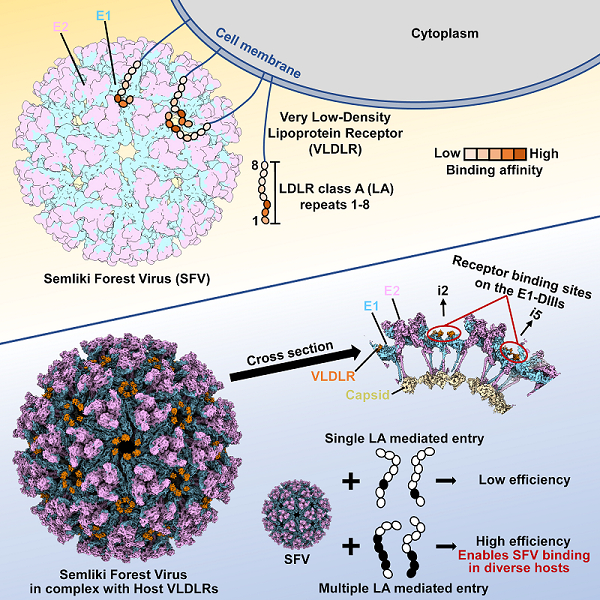
▲The novel receptor mediates cross-species transmission of alphavirus SFV through the synergistic action of multiple tandem LA domains
Although most LA sequences of VLDLR in different species are quite different, they are completely conserved with W132, E137 and D139, which are key residues for viral action. VLDLR's unique synergistic binding mode enables it to tolerate sequence differences between species from different evolutionary levels when mediating viral infection, and realizes virus transmission between multiple species with a wide span.
In conclusion, this study uses structural biology and a variety of biochemical methods to elaborate for the first time the molecular mechanism of evolutionarily conserved universal cell receptors in multiple hosts that bind to viruses specifically through the weak interaction of multiple similar domains, thereby mediating the cross-species invasion of viruses.
Professor Xiang Ye of Tsinghua University School of Medicine and researcher Zhang Xinzheng of the Institute of Biophysics of the Chinese Academy of Sciences are the co-corresponding authors of the paper, and Cao Duanfang, associate researcher of Zhang Xinzheng's research group, Ma Bingting, postdoctoral fellow of Xiang Ye's research group, and Cao Ziyi, doctoral student of Zhang Xinzheng's research group, are co-first authors of the paper. This work has been supported by the Key R&D Project of the Ministry of Science and Technology of China, the Vanke Public Health and Health Discipline Development Special Fund of Tsinghua University, the National Natural Science Foundation of China, the Spring Wind Fund of Tsinghua University, the Beijing Frontier Research Center for Biological Structure, the Strategic Leading Science and Technology Project of the Chinese Academy of Sciences, the Basic Frontier Scientific Research Program of the Chinese Academy of Sciences and the Youth Innovation Promotion Association of the Chinese Academy of Sciences.
Source: 药明康德、学术经纬


 备案号:沪ICP备20003873号-1