


Cell chambers, also called permeability supports, are used to do experiments related to penetration function from the name. At the bottom of the chamber there is a permeable membrane with micropores of different sizes, and the rest of the cup is made of the same material as a normal orifice plate.
01|Common experiments for cell chamber applications
Cell chambers are commonly used in cell experiments, such as co-culture experiments, chemotaxis experiments, tumor cell migration experiments, tumor cell invasion, and cell transport.
Permeable supports can effectively improve the culture of polar cells because they allow cells to secrete and absorb molecules from their basal and apical surfaces, thereby metabolizing in a more natural way, mimicking the in vivo environment to culture certain specific cell lines to the greatest extent.
1
Common experiments in 6-well cell chambers
CACO-2 cell transport model
Using 0.44um membrane, Caco-2 cells were seeded in cell cells at a density of about x10/mL of 0.5mL per well for about 21 days, and the first 1 week was changed every other day and 1 week after 1 week and then every day. At the same time of model establishment, the transmembrane resistance value and alkaline phosphatase activity were monitored to determine whether the model met the requirements of transport experiments.
2
Common experiments in 12-well cell chambers
Co-culture experiments
Less than 3.0 μm pore size, cells do not migrate through, so if the study does not involve cell motility and does not require cells to cross the polycarbonate cool film, a pore size below 3.0 μm should be selected. Planting cell A in the upper chamber and cell B in the lower chamber can study the effect of substances secreted or metabolized by cell B on cell A.
3
Common experiments in 24-well cell chambers
Chemotaxis experiments
With 5.0, 8.0, 12.0μm membranes, the upper chamber cells can pass through the polycarbonate cool membrane into the lower chamber, and counting the number of cells entering the lower chamber can reflect the chemotaxis ability of the lower chamber components on the upper ventricular cells.
a) Chemotaxis of cell B on cell A: By planting cell A in the upper chamber and cell B in the lower chamber, the chemotaxis effect of substances secreted or metabolized by cell B on cell A can be studied.
b) Chemotaxis effect of chemokines on cells: The chemokine on cells can be studied by planting cells in the upper chamber and adding a chemotaxis factor to the lower chamber.
02|Cell chamber product features
The nested bottom has a thin, translucent membrane that reduces the loss of small molecule proteins and other compounds. The upper cutout is easy to access, and the separate chamber is easy to compare and observe. TC treatment promotes cell adhesion; Center hanging design to prevent damage when the cells move; Fixation and staining can be performed during the experiment; Asepsis; No pyrogen (no endotoxin) ; No DNase and RNase; Three sizes to meet a variety of experimental needs.
03|KIRGEN cell chamber recommended
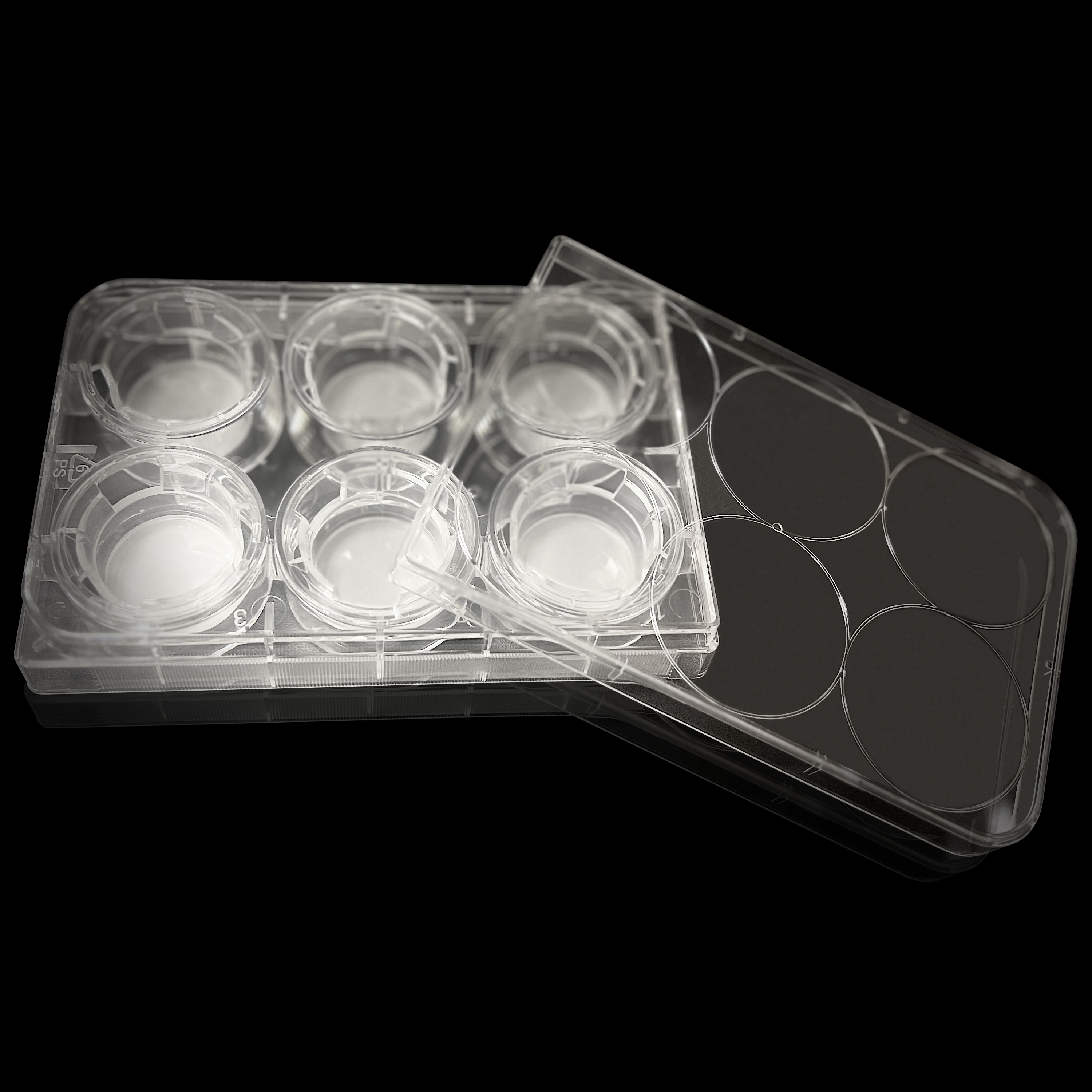
Cell chamber culture plate KG51006
Peculiarity:
● Innovative edge design, easy to dosing
● PC membrane: low adsorption rate, reduce the loss of small molecule proteins and other compounds
● Transparent PET membrane is convenient for observing cell status
● Abundant selection of supporting multi-well plates: 6 wells, 12 wells, 24 wells
● PET film has excellent transparency and better optical clarity
● The PC film is not easy to tear or curl, and it is easy to operate when taking out the chamber
● Compatible with most solvents used for fixation and dyeing


 备案号:沪ICP备20003873号-1