


Kaposi sarcoma-associated herpesvirus (KSHV) is an enveloped double-stranded DNA virus associated with a variety of human malignancies, including Kaposi sarcoma (KS), primary effusion lymphoma, multicenter Castleman disease, and recently reported osteosarcoma in children. KS is a multifocal oligoclonal malignancy with a complex pathogenesis. The origin of spindle-shaped KS cells was originally thought to be an endothelial cell lineage. However, the heterogeneity of spindle-shaped cells has led to the hypothesis that KS may originate from mesenchymal stem cells (MSCs) or precursors of vascular cells. As more evidence is unearthed, this hypothesis has gained more and more support and formed a relatively well-established view that KS may have originated from pluripotent MSCs infected with KSHV, which converts MSCs into KS cells through a process of transformation from mesenchymal to endothelial cells.
On May 24, 2023, Zeng Musheng and Yuan Yan of Sun Yat-sen University jointly published a research paper entitled "Neuropilin 1 is an entry receptor for KSHV infection of mesenchymal stem cell through TGFBR1/2-mediated macropinocytosis" online in Science Advances. The study found that neurociliary protein 1 (NRP1) is a key entry receptor for KSHV infection and showed that NRP1 promotes macrophage proliferation using transforming growth factor-β receptor type 1/2 (TGFBR1/2) transduction to support KSHV entry into MSCs.
Part 01
Relevant research content
Mesenchymal stem cells are a group of pluripotent stem cells with multiple differentiation capabilities. The initial evidence to support infection with KSHV in mesenchymal stem cells is that primary mesenchymal stem cells are susceptible to both cell-free and cell-associated KSHV infection during culture. Different sources of human mesenchymal stem cells allow persistent KSHV infection, which further demonstrates the vulnerability of mesenchymal stem cells to KSHV infection. KSHV effectively infects rat postembryonic renal mesenchymal precursor cells and can undergo cell transformation up to 4 days after infection.
Considering that the oral cavity is the main route of KSHV infection and that oral MSCs can contact saliva, the research team previously investigated the susceptibility of oral MSCs to KSHV infection. Different types of oral mesenchymal stem cells, including periodontal ligament stem cells (PDLSCs), dental pulp stem cells (DPSCs), and gum/mucosal derived mesenchymal stem cells (GMSCs), are highly sensitive to KSHV infection, which promotes MSC differentiation. These studies suggest that MSCs may be the main targets of oral KSHV infection, and that KSHV-infected MSCs may be precursors of KS tumor cells. However, how KSHV infects mesenchymal stem cells remains unclear.
KSHV infection is a complex multi-step process involving the interaction of multiple viral glycoproteins with host receptors. In addition to mesenchymal stem cells, infection of KSHV in different target cells has been studied in depth, and receptors that mediate KSHV entry into these cells have been identified, including integrin, the Ephrin receptor family, cystine/glutamate transporter (xCT) (20), and dendritic cell-specific icam-3-capture non-integrin 1 (DC-SIGN). While MSCs are very sensitive to KSHV infection, how KSHV enters MSCs has not been explored. In particular, host factors mediating KSHV infection and the mechanisms controlling KSHV's entry into mesenchymal stem cells remain unrevealed.
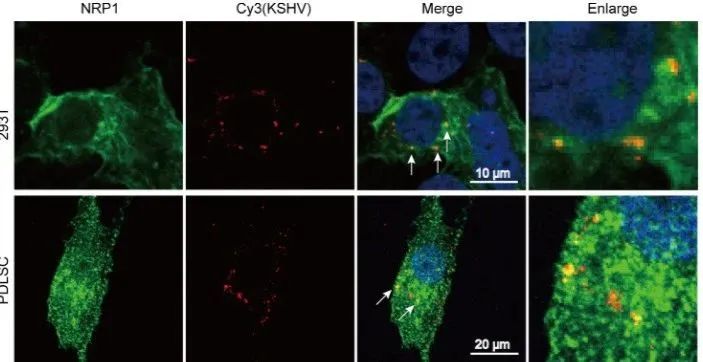
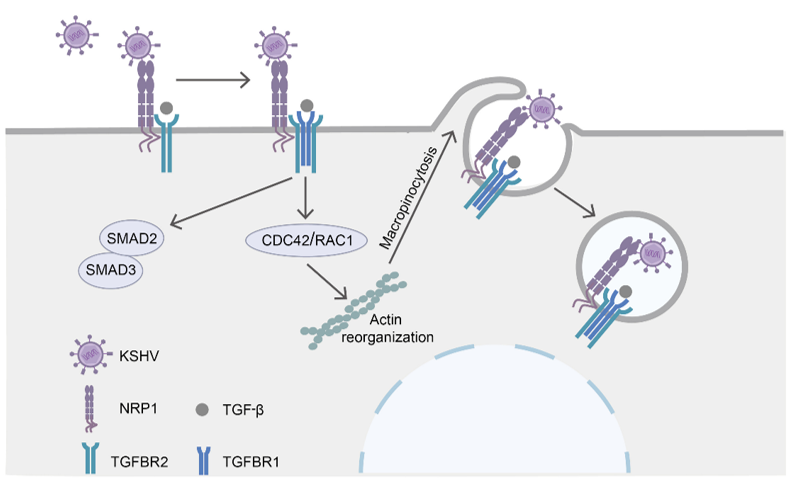
Using a combination of bioinformatics analysis and shRNA screening, the researchers determined that neurociliary protein 1 (NRP1) is an entry receptor for KSHV infection with MSCs. Functionally, NRP1 knockout and overexpression in MSCs significantly reduced and promoted KSHV infection, respectively. In terms of mechanism, NRP1 promotes KSHV binding and internalization by interacting with KSHV glycoprotein B (gB), while soluble NRP1 protein blocks KSHV glycoprotein B. In addition, NRP1 interacts with TGF-β receptor 2 (TGFBR2) through their respective cytoplasmic domains, thereby activating the TGFBR1/2 complex, thereby promoting macrophage-mediated KSHV internalization via small GTPase Cdc42 and Rac1. Together, these findings suggest that KSHV has evolved a strategy to invade MSCs by utilizing NRP1 and TGF-β receptors to stimulate macrophages.


 备案号:沪ICP备20003873号-1