


Researchers at the Hebrew University of Jerusalem in Israel are trying to restore color vision in completely colorblind subjects through gene therapy. In their paper "Seeing color following gene augmentation therapy in Achromatopsia," published in Current Biology, the team details the success and limitations of the approach in patients with total color blindness who lack the functional CNGA3 gene.
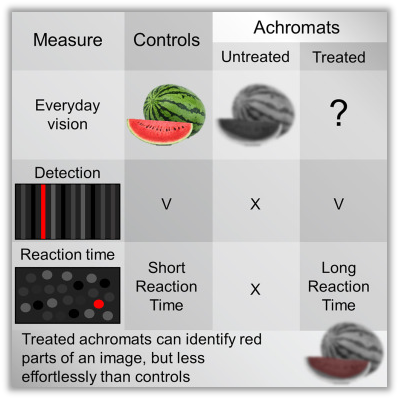
After a complete copy of the CNGA3 gene (the cone-specific opsin promoter) was implanted in one eye by gene amplification therapy, all four subjects reported that they saw a specific visual stimulus differently than before the treatment. While still technically colorblind, enhanced vision enables patients to perceive "red" alone, or at least long-wavelength red, very different from their previous visual abilities.
Color blindness has a variety of causes, and the severity varies depending on the cause. Some people can restore color vision to a large extent by correcting the overlap of cone wavelength perception by using wavelength separation glasses, but some lack normal cones altogether. Cones provide color vision and bright light vision, while rods provide grayscale vision in low light.
Hypochromatic vision disorder is a rare inherited visual disorder that affects about 1 in 30,000 people and is characterized by no color vision, decreased vision, sensitivity to light, and nystagmus (rapid eye movements). Unlike typical color blindness, chromatia involves more severe visual symptoms and a complete lack of functional cones. The disease is present from birth and does not worsen over time.
A mutation in one of the six genes causes color weakness. These mutations disrupt the normal function of the cone in the retina, which affects color vision. The disorder can also affect visual acuity, with most people with color weakness having an average visual acuity of 20/200, which is legally blind.
There are two types of color weakness - complete and incomplete. Complete patients do not have a functional cone on the retina and therefore develop more severe visual symptoms. In the incomplete type, some frustas are still functional, so the symptoms are milder than in the complete type.
Patients treated for color deficiency in this study had complete color deficiency due to the lack of the CNGA3 gene, which plays a key role in cone photoreceptor function. The researchers hope to restore the function of the cone by restoring the gene.
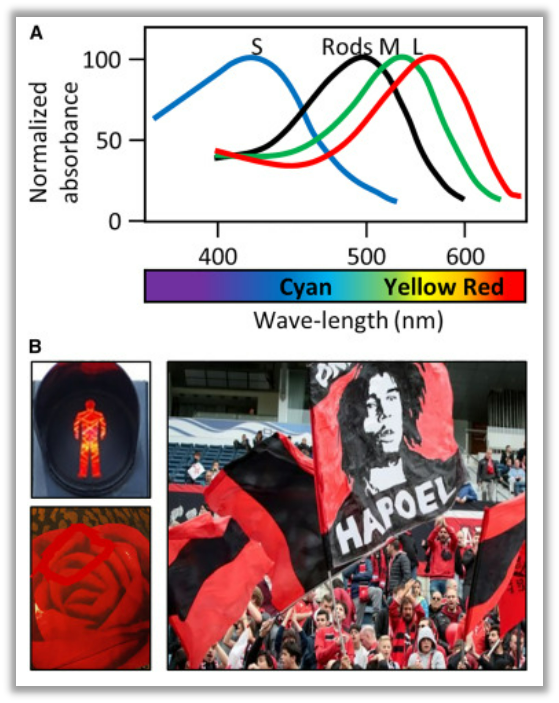
After the treatment, the patient's color vision did not change, but what they saw was indeed different than before. Color is perceptible to some extent to the eyes of all treated patients, with red stimuli being the most perceptible. This detection is slow, requires concentration, and is well below the level of normal color vision.
What would it look like to see a new color for the first time?
Patients struggle to find the right words to describe their perception of a red stimulus, which they say emits a different light, sparkles, or appears on a different plane than the background. When the luminance cues were eliminated, there was no change in the patient's perceived color brightness and ability to detect color cues, suggesting that luminance was not a major component of patient-reported color perception.
The authors speculate that even after treatment, the patient's rod cells may continue to function under light conditions, overwhelming the signals generated by the cones and preventing the appearance of panchromatic sensations.
Functional and structural differences in the visual cortex, as well as morphological changes due to long-term deprivation of color signals, may also be responsible for incomplete recovery of color vision. In tests conducted after 1-3 years of treatment, few signs were found of additional processing of color perception by brain plasticity.
While the improvement is limited, it is an improvement. It also suggests that in addition to direct genetic factors, there are other factors that can be isolated and studied, creating a more comprehensive treatment. As with any good study, further research is needed.
This article is transferred from: Frontiers in Life Sciences
© The data comes from the Internet, and the infringement is deleted
Reference: Ayelet McKyton et al, Seeing color following gene augmentation therapy in achromatopsia, Current Biology (2023). DOI: 10.1016/j.cub.2023.06.041


 备案号:沪ICP备20003873号-1